Task 1 · Process Diagram
You should spend about 20 minutes on this task. Write at least 150 words.
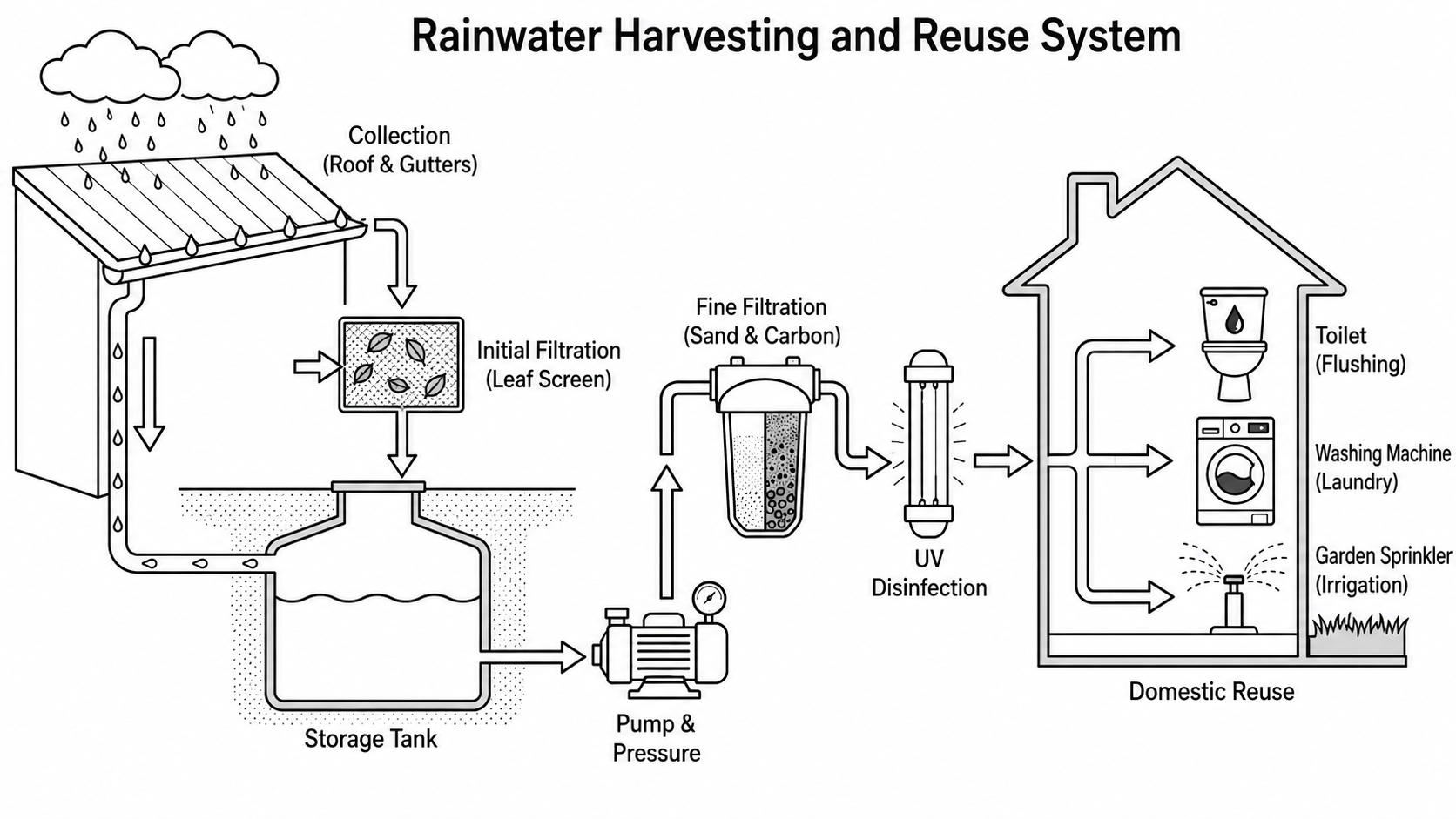
The diagram below illustrates the process by which rainwater is collected, treated, and reused for domestic purposes in a residential property.
Summarise the information by selecting and reporting the main features.
Want to see your estimated band score?
Check your writing scorePart 1 · Band 9 Sample Answer
The diagram shows how rainfall captured at a residential property passes through a series of collection, storage and treatment stages before being supplied for domestic reuse.
Overall, this is a linear process beginning with rain falling onto the roof and ending with the treated water being used for toilet flushing, laundry and garden irrigation. Before reuse, the water undergoes two forms of filtration, is held in an underground tank, and is subsequently pumped and disinfected with ultraviolet light.
Initially, rainwater landing on the sloping roof runs into gutters positioned along its lower edge. It is then channelled through a downpipe towards an initial filtration unit fitted with a leaf screen. At this point, leaves and other large debris are separated from the collected water. The screened rainwater then flows into a storage tank installed below ground beside the house.
When water is required, it leaves the base of this tank and enters a pump. This equipment draws the supply onwards and provides the pressure needed for the remaining stages. The pressurised water travels upwards into a fine filtration device containing layers of sand and carbon, which remove smaller impurities not captured by the first screen.
Following fine filtration, the water passes through a separate ultraviolet disinfection unit. The resulting treated supply is then conveyed into the property and divided among three outlets. One branch feeds a toilet for flushing, another supplies a washing machine for laundry, and the final branch leads outside to a garden sprinkler used for irrigation.
Part 1 · Band 8 Sample Answer
The illustration shows a household system that collects rainwater, cleans it and supplies it for domestic purposes.
Overall, rain is first gathered from the roof and stored underground after an initial screening stage. It is later pumped through fine filtration and ultraviolet disinfection before being distributed to a toilet, washing machine and garden sprinkler. The process is linear and consists of collection, storage, treatment and reuse.
At the first stage, rain falls onto the roof of the property and is directed into gutters. From there, it moves down a pipe to an initial filter containing a leaf screen. This screen prevents leaves and larger unwanted materials from continuing through the system. The filtered water then passes into a tank located beneath ground level, where it remains until needed.
The next part of the process begins when water is drawn from the storage tank by a pump. Besides moving the water forwards, this device provides pressure for its passage through the treatment equipment. The supply first enters a fine filter that contains sand and carbon. This represents a more detailed filtration stage than the earlier leaf screen.
Afterwards, the water flows into a UV unit, where it is disinfected. It is then ready to be returned to the residential property through a shared supply line. Inside and around the house, the treated rainwater is used in three ways: it provides water for flushing the toilet, supplies the washing machine for laundry, and feeds an outdoor sprinkler that irrigates the garden.
Part 1 · Band 7 Sample Answer
The diagram illustrates the stages involved in collecting and treating rainwater so that it can be reused in and around a home.
Overall, the process starts when rain falls on the roof and finishes when treated water is supplied for three domestic uses. The main stages are collection, initial filtration, underground storage, pumping, fine filtration and UV disinfection. The system does not return the water to the beginning after use.
First, rainwater runs down the roof and enters the gutters. It is carried through a pipe to an initial filtration box, where a leaf screen removes leaves and other large materials. After passing through this screen, the water flows into a storage tank under the ground.
Next, water from the tank is sent through a pump, which moves it through the later parts of the system and provides pressure. It then enters a fine filter containing sand and carbon. This second filtration stage treats the water more thoroughly than the leaf screen.
The filtered water subsequently passes through a UV disinfection unit. Once this stage has been completed, the treated water travels through a pipe into the house. It is divided between two indoor uses and one outdoor purpose. Indoors, it is supplied to a toilet for flushing and to a washing machine for doing laundry. The remaining water is directed to a garden sprinkler and used for irrigation.