ACADEMIC WRITING SAMPLE ANSWERS

Academic Writing Sample Answers Practice 7 Test 03

This original practice page includes Task 1 (Dynamic Multiple-Line Graph) and Task 2 (Discuss Both Views and Give Your Opinion), with Band 9, Band 8, and Band 7 sample answers for IELTS preparation.
Academic Writing Task 1

Task 1 · Dynamic Multiple-Line Graph

Task 1 Prompt

You should spend about 20 minutes on this task. Write at least 150 words.

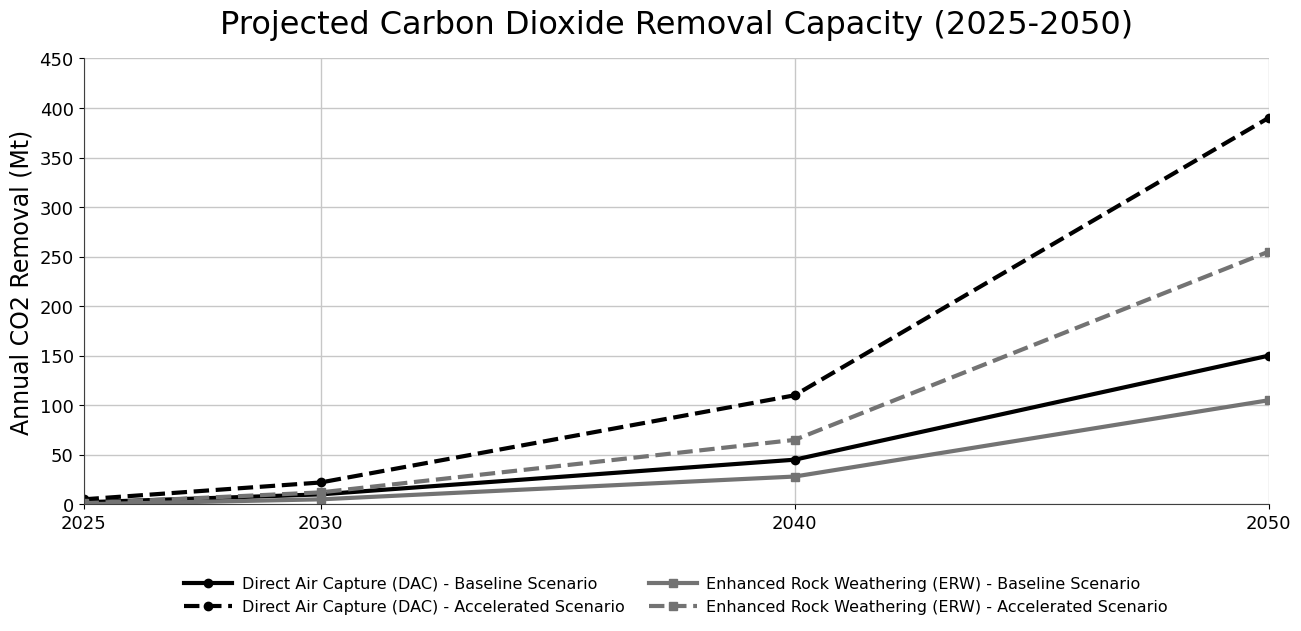
The graph below shows the projected annual carbon dioxide removal capacity of two technologies—Direct Air Capture (DAC) and Enhanced Rock Weathering (ERW)—under two different policy scenarios (Baseline and Accelerated) from 2025 to 2050.

Summarise the information by selecting and reporting the main features, and make comparisons where relevant.
Academic Writing Task 1 Dynamic Multiple-Line Graph practice image
BAND 9

Part 1 · Band 9 Sample Answer

The line graph compares the projected annual carbon dioxide removal capacity of Direct Air Capture and Enhanced Rock Weathering between 2025 and 2050 under baseline and accelerated policy scenarios. Capacity is measured in millions of tonnes.

Overall, all four projections rise throughout the period, with growth expected to be particularly rapid after 2040. DAC is forecast to outperform ERW under the equivalent policy setting, while accelerated policies produce substantially greater capacity than the baseline in both cases. By 2050, accelerated DAC is projected to be the dominant option by a considerable margin.

In 2025, the removal capacities of both technologies are expected to be negligible under either scenario. By 2030, accelerated DAC is forecast to reach approximately 25 Mt annually, compared with about 10 Mt under the baseline. The equivalent ERW figures are lower, at roughly 15 Mt and 5 Mt respectively. These differences become more pronounced by 2040, when DAC capacity is predicted to stand at 110 Mt with accelerated action and 45 Mt without it. ERW is projected to reach around 65 Mt and 30 Mt.

During the final decade, capacity increases sharply across all categories. Accelerated DAC is anticipated to climb by 280 Mt to approximately 390 Mt in 2050, while accelerated ERW reaches about 255 Mt. The baseline estimates remain much lower, at 150 Mt for DAC and just over 100 Mt for ERW. Notably, however, accelerated ERW is expected to exceed baseline DAC from 2040 onwards.

BAND 8

Part 1 · Band 8 Sample Answer

The graph illustrates predicted changes in the annual carbon dioxide removal capacity of Direct Air Capture and Enhanced Rock Weathering from 2025 to 2050. For each technology, projections are provided for baseline and accelerated policy scenarios, with capacity expressed in Mt.

Overall, removal capacity is expected to increase for every category, especially between 2040 and 2050. DAC remains ahead of ERW when the same policy scenario is compared, and accelerated policies lead to far higher results than baseline policies. The accelerated DAC projection is the highest throughout and reaches almost 400 Mt by the end of the period.

All four figures begin at very low levels in 2025. In 2030, DAC is forecast to remove about 10 Mt annually under the baseline scenario, rising to approximately 25 Mt with accelerated policies. ERW is expected to achieve lower capacities of around 5 Mt and 15 Mt respectively. By 2040, the two DAC projections increase to roughly 45 Mt and 110 Mt. In comparison, ERW is predicted to reach about 30 Mt under baseline policies and 65 Mt under accelerated ones.

Much larger gains are forecast over the following decade. By 2050, baseline DAC capacity is expected to reach 150 Mt, compared with just over 100 Mt for baseline ERW. Under accelerated policies, the figures rise to approximately 390 Mt for DAC and 255 Mt for ERW. Thus, accelerated ERW alone is projected to have a considerably greater capacity than either technology achieves in the baseline scenario.

BAND 7

Part 1 · Band 7 Sample Answer

The line graph shows the projected amount of carbon dioxide that Direct Air Capture and Enhanced Rock Weathering will remove each year between 2025 and 2050. Both technologies are shown under baseline and accelerated policy scenarios, and the figures are measured in Mt.

Overall, the capacity of both technologies is predicted to rise in each scenario. Accelerated policies are expected to produce much higher figures than baseline policies, particularly towards 2050. DAC is also forecast to remove more carbon dioxide than ERW when they are compared under the same scenario.

In 2025, all four removal figures are close to zero. By 2030, DAC is expected to reach about 10 Mt under the baseline scenario and 25 Mt under the accelerated one. The figures for ERW are lower, at approximately 5 Mt and 15 Mt respectively. In 2040, baseline DAC is predicted to increase to around 45 Mt, while accelerated DAC reaches 110 Mt. ERW is forecast to provide about 30 Mt of baseline capacity and 65 Mt with faster policy action.

The most significant increases are expected during the final ten years. Baseline DAC is projected to rise to 150 Mt in 2050, compared with just over 100 Mt for baseline ERW. Meanwhile, accelerated DAC climbs to roughly 390 Mt, making it the highest figure on the chart. Accelerated ERW also grows strongly to approximately 255 Mt, which is well above both baseline projections.

Academic Writing Task 2

Task 2 · Discuss Both Views and Give Your Opinion

Task 2 Prompt

You should spend about 40 minutes on this task. Write at least 250 words.

Write about the following topic:

Some people believe that blockchain and other decentralised technologies can increase trust and transparency, reduce corruption and make governments and traditional financial institutions less necessary. Others argue that these technologies have practical limitations and still require effective regulation and public institutions.

Discuss both these views and give your own opinion.

Give reasons for your answer and include any relevant examples from your own knowledge or experience.

BAND 9

Part 2 · Band 9 Sample Answer

Blockchain and related decentralised systems are promoted as a way to replace trust in powerful intermediaries with records that participants can verify for themselves. Advocates believe this could expose corruption and reduce dependence on banks and governments, whereas critics emphasise technical constraints and the continuing need for regulation. In my view, these technologies can strengthen accountability in carefully chosen applications, but they redistribute trust rather than eliminate it, so capable public institutions remain indispensable.

The attraction of decentralisation is understandable. On a conventional database, a single administrator may alter or conceal information, while a well-designed distributed ledger creates a shared history that is extremely difficult for one participant to rewrite. Governments could use this feature to publish procurement transactions, track the distribution of public funds or record ownership changes, allowing auditors and citizens to detect suspicious patterns. In finance, decentralised networks can also transfer value across borders without several layers of intermediaries, potentially reducing delays and fees for people poorly served by banks. Rules encoded in software may additionally ensure that payments are released only when agreed conditions are met.

However, a transparent ledger does not guarantee truthful information or fair outcomes. If an official enters a false land record or a sensor supplies inaccurate data, blockchain may merely preserve the error. Software can contain defects, users can lose private keys, and control may become concentrated among major developers, token holders or computing providers. Full transparency can also conflict with privacy, while anonymous transfers may facilitate fraud or money laundering. Most importantly, many disputes concern events outside the network. Code cannot independently determine whether a contractor built a safe bridge, whether coercion occurred or who legally owns stolen assets.

These limitations explain why regulation and institutions are still required. Courts must resolve contested rights; regulators must establish consumer protection, cybersecurity and financial standards; and elected authorities must decide which rules serve the public interest. A sensible approach is therefore hybrid. Public agencies and financial institutions can use distributed ledgers to make selected records auditable, while retaining lawful procedures for correcting mistakes, protecting confidential information and appealing decisions. Independent technical audits should also examine the software and the distribution of control.

In conclusion, decentralised technologies can make manipulation more difficult and certain transactions more efficient. Nevertheless, they cannot supply accurate real-world data, democratic legitimacy or justice on their own. They should be used to make institutions more transparent and effective, not as a reason to dispense with them.

BAND 8

Part 2 · Band 8 Sample Answer

Decentralised technologies such as blockchain allow information and transactions to be recorded across a network rather than controlled by one organisation. Some people expect this model to reduce corruption and replace much of the work performed by governments and banks. Others believe its practical weaknesses make regulation and public institutions essential. I agree that decentralisation can improve transparency and efficiency, but I do not think it can remove the need for trusted institutions.

Supporters point out that entries on a blockchain are difficult to change secretly because copies of the record are held and checked by many participants. This could make public spending easier to monitor. For example, funds allocated to a construction project could be traced from the government budget to contractors, making unexplained transfers more visible. The same technology can enable people to send money directly without relying on several banks or payment companies. Automated agreements may also complete routine transactions quickly once clearly defined conditions have been satisfied.

Despite these benefits, blockchain has significant limitations. It can confirm that stored information has not been altered, but it cannot prove that the original information was correct. A dishonest official could enter false data, and a faulty computer program could apply an unfair rule consistently. These systems may also be difficult for ordinary citizens to use, while lost passwords, online fraud and unstable digital assets can cause serious financial losses. In addition, permanent public records may expose personal information that should remain private.

Effective institutions are needed to deal with these problems. Regulators can require service providers to protect customers, explain risks and prevent illegal transfers. Courts are necessary when ownership is disputed, a contract was signed under pressure or an automated transaction must be reversed. Governments also have democratic responsibilities that software cannot perform, such as balancing public interests and deciding how resources should be distributed.

In my opinion, the most useful approach is to combine the strengths of both systems. Banks and public agencies could use decentralised records for transactions that benefit from independent verification, while human authorities maintain privacy rules, correction procedures and channels of appeal. This would use technology to improve institutions rather than attempt to abolish them.

In conclusion, blockchain can make some records clearer and reduce dependence on intermediaries, but it cannot solve corruption or create fair rules by itself. Strong regulation and accountable public institutions will remain necessary.

BAND 7

Part 2 · Band 7 Sample Answer

Blockchain records information across a network instead of keeping it under the control of one central organisation. Some people believe this can create greater trust, reduce corruption and make banks or governments less important. Others argue that decentralised technology has serious limits and must still be controlled by effective institutions. In my opinion, blockchain can improve certain services, but it should support traditional institutions rather than replace them.

There are several possible advantages. Information stored on a blockchain is difficult for one person to change without other users noticing. This could make government spending more transparent because citizens and auditors could follow how public money is transferred. It may therefore be harder for officials to hide improper payments. Decentralised financial systems can also allow users to send money directly to one another. This may make some international payments faster and cheaper by removing unnecessary intermediaries.

However, the technology cannot guarantee that every record is true. If incorrect information is entered at the beginning, the system may keep that mistake permanently. Computer code can also contain errors, and criminals may exploit weaknesses or steal access details. Ordinary users who lose a password or private key may have no simple way to recover their money. Furthermore, public records can create privacy problems, and some decentralised financial products change greatly in value.

For these reasons, governments and other institutions remain necessary. Regulators need to set safety standards, protect consumers and investigate illegal activity. Courts are still required when people disagree about ownership or when an automated payment produces an unfair result. Technology cannot decide difficult social questions or represent the interests of citizens in the way that elected governments are expected to do.

I believe a combined system is the best option. Governments and banks can use blockchain where a clear and shared record is valuable, such as tracking public contracts or payments. At the same time, trained officials should verify the original information, and users should have a legal process for correcting errors and appealing decisions.

In conclusion, decentralised technologies can increase transparency and improve some transactions. Nevertheless, they have technical and social limitations, so strong public institutions and sensible regulation will continue to be needed.

FREE PRACTICE RESOURCES

Download the IELTS Practice PDF Pack.

Get Listening, Reading, and Writing practice materials for self-study. Use a computer to download the 1.9GB pack.

Download PDF Pack
Chat History
My Notes