Task 1 · Timeline Diagram
You should spend about 20 minutes on this task. Write at least 150 words.
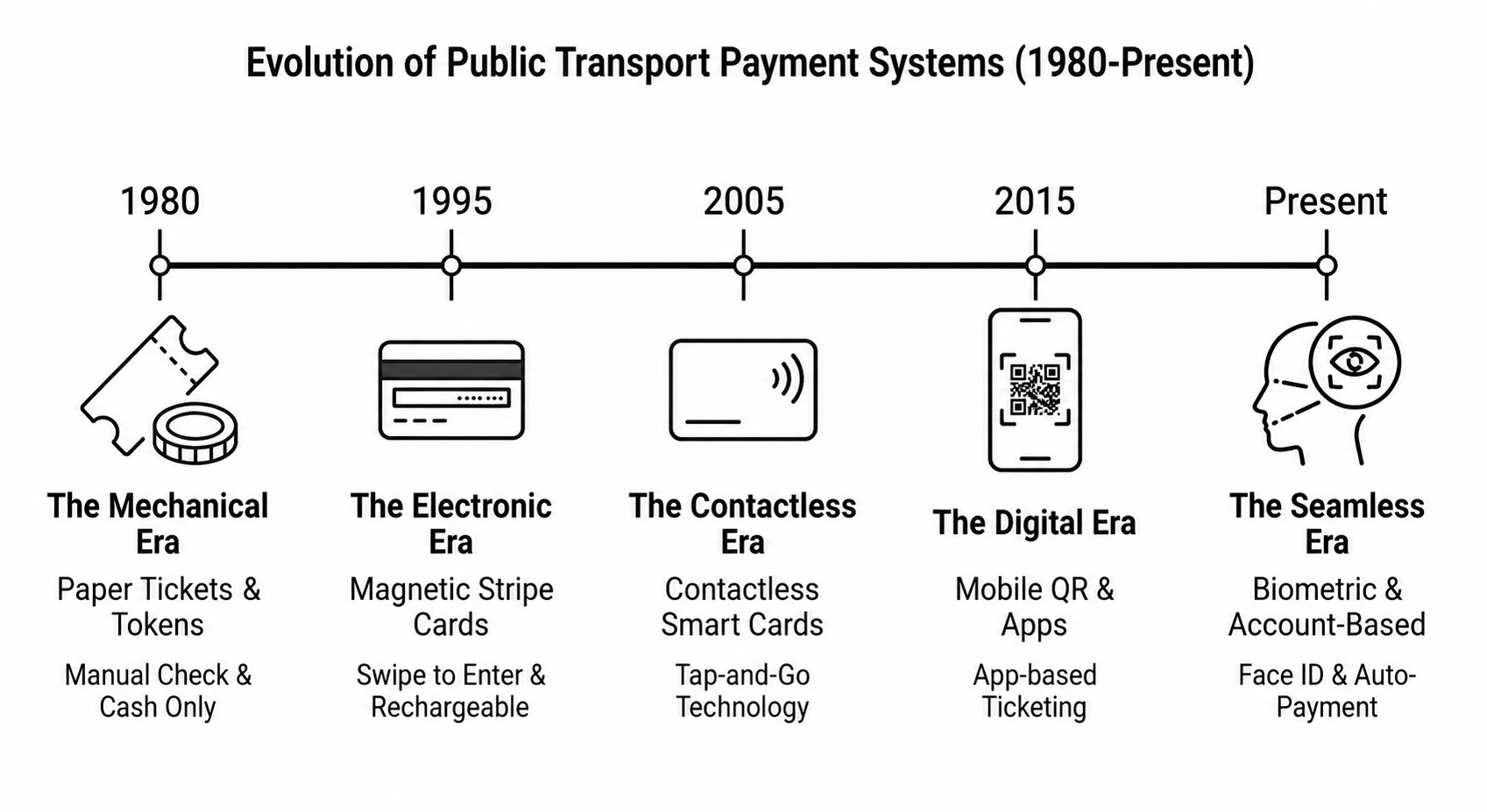
The diagram below illustrates the evolution of public transport payment systems in a major city from 1980 to the present day, showing the key technologies introduced in each phase.
Summarise the information by selecting and reporting the main features, and make comparisons where relevant.
Want to see your estimated band score?
Check your writing scorePart 1 · Band 9 Sample Answer
The diagram traces five stages in the development of payment systems for public transport in a major city, from mechanically processed tickets in 1980 to the seamless biometric arrangements used today.
Overall, the system has progressed from cash-dependent, manually checked physical tickets to increasingly automated and less tangible payment methods. At the point of entry, manual inspection was followed by swiping, tapping and mobile scanning, before the introduction of facial identification linked to automatic payment.
In 1980, during the mechanical era, passengers used paper tickets or tokens. These could be obtained only with cash and had to be checked manually. The first electronic alternative appeared in 1995, when rechargeable magnetic-stripe cards were introduced. Rather than presenting a ticket to an employee, travellers swiped a card to enter the network, although contact with a reader was still required.
The contactless era began in 2005 with smart cards incorporating tap-and-go technology. This removed the need to swipe a magnetic strip. A further transition occurred in 2015, when payment moved onto mobile devices. QR codes and transport applications enabled app-based ticketing, so a separate travel card was no longer the only electronic option.
At present, the city has entered what the diagram calls the seamless era. The latest arrangement is both biometric and account-based: Face ID identifies the passenger, while the associated account handles payment automatically. Compared with the entirely manual process of 1980, the current system combines identification, entry and payment with minimal direct action from the traveller.
Part 1 · Band 8 Sample Answer
The diagram shows how payment for public transport in a major city has developed through five technological phases between 1980 and the present.
Overall, payment has changed from a manual system based on cash, paper tickets and tokens to an automated system using biometric identification and linked accounts. Passengers moved from showing a ticket to swiping or tapping a card, then using mobile technology, and finally making payments automatically through Face ID.
In 1980, the city was in the mechanical era. Travellers paid only in cash and received either paper tickets or tokens, which staff checked manually. The electronic era followed in 1995. Magnetic-stripe cards could be recharged and were swiped at the entrance, allowing the same card to be used repeatedly.
A decade later, in 2005, contactless smart cards were introduced. These used tap-and-go technology, eliminating the need to pass a magnetic strip through a reader. The digital era then began in 2015, when mobile QR codes and applications allowed tickets to be stored and used on a phone through an app-based system.
The most recent stage is described as the seamless era. Payment is now account-based and uses biometric technology. Instead of handling cash, presenting a ticket or scanning a card or QR code, a passenger can be recognised through Face ID and charged automatically. Thus, the main trend has been towards less reliance on physical payment items and progressively lower manual involvement.
Part 1 · Band 7 Sample Answer
The diagram illustrates the development of public transport payment in a large city from 1980 to the present. It divides this development into five eras, each based on a different type of technology.
Overall, the payment system became more digital and automatic over time. It started with cash payments and manually checked paper tickets or tokens. These were followed by different types of cards, mobile tickets and, finally, biometric identification with automatic payment.
In 1980, the city used a mechanical system. Passengers could pay only with cash and received paper tickets or tokens. These items had to be checked manually. In 1995, magnetic-stripe cards were introduced as part of the electronic era. The cards were rechargeable, and passengers swiped them to enter the transport system.
The next stage began in 2005. Contactless smart cards replaced the need to swipe, as travellers could use tap-and-go technology. In 2015, the system entered the digital era. Mobile QR codes and apps allowed passengers to use app-based tickets on their phones instead of relying only on travel cards.
At present, the system is in the seamless era. It uses biometric and account-based technology. Face ID can recognise a passenger, and the fare is paid automatically through the connected account. Compared with 1980, the modern process requires much less action from both passengers and transport workers, and cash and manual checking are no longer central to the payment procedure.