ACADEMIC WRITING SAMPLE ANSWERS

Academic Writing Sample Answers Practice 4 Test 02

This original practice page includes Task 1 (Static Table) and Task 2 (Discuss Both Views and Give Your Opinion), with Band 9, Band 8, and Band 7 sample answers for IELTS preparation.
Academic Writing Task 1

Task 1 · Static Table

Task 1 Prompt

You should spend about 20 minutes on this task. Write at least 150 words.

The table below compares three countries in terms of GDP per capita, environmental sustainability and social well-being.

Summarise the information by selecting and reporting the main features, and make comparisons where relevant.
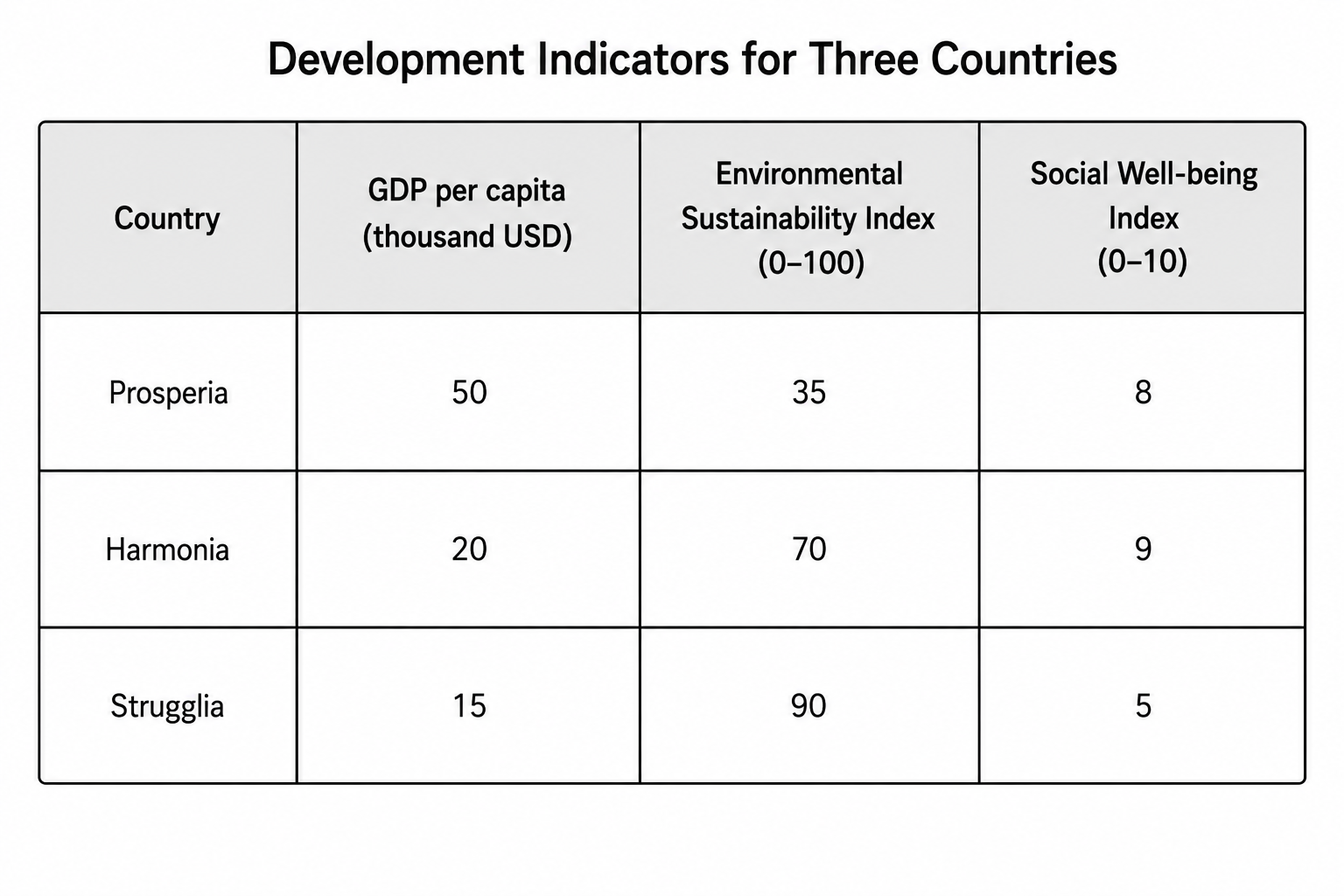
Academic Writing Task 1 Static Table practice image
BAND 9

Part 1 · Band 9 Sample Answer

The table compares Prosperia, Harmonia and Strugglia using three measures of development: GDP per person, environmental sustainability and social well-being.

Overall, none of the three countries ranks first across all indicators. Prosperia is by far the wealthiest but has the weakest environmental performance, while Strugglia displays the reverse pattern. Harmonia occupies an intermediate economic and environmental position and records the highest level of social well-being.

Prosperia has a GDP per capita of $50,000, which is two and a half times Harmonia’s figure of $20,000 and more than three times the $15,000 recorded in Strugglia. Despite this considerable economic advantage, its environmental sustainability score is only 35 out of 100, the lowest in the table. Nevertheless, Prosperia performs relatively well socially, with an index value of 8 out of 10.

Harmonia achieves the strongest social well-being result, at 9, despite having a GDP per head that is $30,000 below Prosperia’s. Its environmental index stands at 70, exactly double the score for Prosperia but 20 points below that of Strugglia. Although Strugglia leads environmental sustainability with an impressive score of 90, it has both the lowest GDP per capita, at $15,000, and the poorest social well-being result, at 5. Thus, greater environmental performance is not consistently associated with either higher income or stronger social outcomes in these countries.

BAND 8

Part 1 · Band 8 Sample Answer

The table provides information about GDP per capita, environmental sustainability and social well-being in three countries: Prosperia, Harmonia and Strugglia.

Overall, each country performs strongly in a different area. Prosperia has the highest income but the lowest environmental score, whereas Strugglia is the most environmentally sustainable despite being the poorest. Harmonia has the highest social well-being index and ranks between the other two countries on the remaining measures.

At $50,000, GDP per person in Prosperia is considerably higher than the figures for Harmonia and Strugglia, which stand at $20,000 and $15,000 respectively. However, Prosperia receives an environmental sustainability score of just 35 out of 100. This is half Harmonia’s result of 70 and substantially below Strugglia’s leading figure of 90.

The pattern is different for social well-being. Harmonia ranks first with 9 points out of 10, one point higher than Prosperia. This is notable because Harmonia’s GDP per capita is less than half that of Prosperia. Strugglia, meanwhile, has the lowest social score, at 5, even though it performs best environmentally. Its income per head is also the smallest, only $5,000 below Harmonia’s but $35,000 lower than Prosperia’s. The figures therefore show that the country with the greatest wealth does not lead in either environmental sustainability or social well-being.

BAND 7

Part 1 · Band 7 Sample Answer

The table compares three countries called Prosperia, Harmonia and Strugglia in terms of income per person, environmental sustainability and social well-being.

Overall, Prosperia is the richest country, while Strugglia has the best environmental result. Harmonia receives the highest score for social well-being. This means that no country has the highest figure in all three categories.

Prosperia has a GDP per capita of $50,000, which is much higher than the other two countries. Harmonia’s figure is $20,000, while Strugglia has the lowest income per person at $15,000. However, the order is completely different for environmental sustainability. Strugglia has the highest score at 90 out of 100, followed by Harmonia at 70. Prosperia is in last place in this category, with an index of only 35.

For social well-being, Harmonia records the best result of 9 out of 10. Prosperia is close behind with a score of 8, even though its environmental result is much lower. Strugglia has a social well-being index of 5, the lowest of the three countries. Therefore, although Strugglia performs very well in protecting the environment, this is not matched by its economic or social figures. Similarly, Prosperia’s high level of wealth does not result in the strongest environmental or social scores.

Academic Writing Task 2

Task 2 · Discuss Both Views and Give Your Opinion

Task 2 Prompt

You should spend about 40 minutes on this task. Write at least 250 words.

Write about the following topic:

Deepfakes, automated online accounts and targeted false information are increasingly being used to influence people’s political and commercial opinions. Some people believe that governments should strictly regulate online platforms to protect public debate. Others argue that such regulation may restrict freedom of expression and that improving people’s digital literacy is a better solution.

Discuss both views and give your own opinion.

Give reasons for your answer and include any relevant examples from your own knowledge or experience.

BAND 9

Part 2 · Band 9 Sample Answer

The growing use of deepfakes, automated accounts and precisely targeted disinformation has intensified debate over how online communication should be governed. Some favour strict regulation of digital platforms, while others fear state control and prefer education as the principal defence. In my view, regulation is necessary when it is narrowly directed at deceptive conduct, but it must be combined with stronger digital literacy and safeguards for legitimate expression.

Those supporting regulation argue that individual users cannot reasonably identify every sophisticated manipulation. A realistic fabricated video can spread to millions before independent investigators establish that it is false, while networks of automated accounts can make a marginal opinion appear widely accepted. Platforms also have commercial incentives to promote material that attracts attention, regardless of its accuracy. Governments can therefore require companies to label synthetic media, disclose political advertising, remove coordinated bot networks and preserve information about who paid for targeted campaigns. Clear duties of this kind would make manipulation more difficult without requiring officials to decide whether every controversial statement is true.

Opponents, however, rightly warn that broad regulation can threaten freedom of expression. Concepts such as harmful information or political misinformation may be defined so vaguely that authorities suppress criticism, satire or minority opinions. Even democratic governments can make errors, and platform moderators may remove lawful content simply to avoid penalties. Digital literacy offers a less coercive response by teaching people to examine sources, recognise emotional manipulation, compare reports and understand how recommendation systems operate. These skills remain useful as technologies and political circumstances change.

Nevertheless, education alone places an unrealistic burden on the public. Even highly informed users cannot investigate the origin of every post or detect synthetic material created with advanced tools. I therefore favour a combined approach. Laws should focus on transparent, verifiable behaviour, such as undisclosed paid advertising, impersonation, automated amplification and fraudulent alteration of audio or video. Decisions should be open to appeal and reviewed by independent courts rather than controlled solely by ministers. At the same time, schools, libraries and public broadcasters should provide continuing digital-literacy education.

In conclusion, unrestricted government power could silence legitimate speech, but relying only on users to defend themselves would leave organised manipulation largely untouched. Carefully limited regulation, reinforced by public education and independent oversight, offers the most effective and proportionate solution.

BAND 8

Part 2 · Band 8 Sample Answer

Artificially created videos, automated accounts and targeted misleading content are becoming more influential in political and commercial communication. While some people believe governments must impose strict rules on online platforms, others argue that regulation could limit free speech and that digital education would be more effective. I believe both measures are needed, provided that regulation targets deceptive practices rather than unpopular opinions.

There are strong reasons for government action. Deepfakes can make public figures appear to say or do things that never happened, and large groups of automated accounts can spread the same message until it seems credible or popular. Ordinary users may not have the time or technical knowledge to identify such campaigns. In addition, online platforms benefit financially when sensational content generates clicks and advertising revenue, so voluntary action may be insufficient. Governments could require clear labels on synthetic media, public records of political advertisements and the removal of accounts proven to be automated and deceptive. Such rules would increase transparency and make platforms more accountable.

However, strict regulation also creates serious risks. A government may define false information too broadly and use the law to remove criticism or inconvenient reporting. Platforms facing large fines might also delete lawful material whenever its accuracy is disputed. This could damage open political discussion. Supporters of digital literacy therefore argue that people should learn how to check the original source of a claim, compare several reliable reports and recognise when content is designed mainly to provoke an emotional response. Educated users are less dependent on governments or technology companies to decide what they may see.

In my opinion, digital literacy is essential but cannot solve the problem by itself. A trained person may still be unable to detect a highly convincing fake video or discover that thousands of accounts belong to one organised network. Governments should therefore regulate conduct that can be objectively demonstrated, including hidden sponsorship, impersonation and coordinated automated activity. Independent courts and a clear appeals process should protect legitimate speech. Meanwhile, digital-literacy lessons should be included in schools and made available to adults.

In conclusion, education helps people judge online material independently, whereas carefully designed regulation addresses manipulation that individuals cannot tackle alone. Combining these approaches is safer and more effective than relying entirely on either one.

BAND 7

Part 2 · Band 7 Sample Answer

Deepfake videos, automated accounts and false online information are now used to affect political views and buying decisions. Some people think governments should control online platforms more strictly, while others believe this could reduce freedom of speech and prefer better digital education. In my opinion, governments should introduce limited rules, but digital literacy should also be improved.

Strict regulation can help protect the public from organised deception. Many internet users cannot easily recognise a realistic fake video or know whether an account is operated by a real person. False content can spread very quickly, especially when thousands of automated accounts repeat it. Online companies may also be slow to act because popular and shocking posts attract users and generate advertising income. Governments could require platforms to label computer-generated videos, identify paid political advertisements and close accounts that are clearly part of deceptive bot networks. These measures would give users more information before they form an opinion.

On the other hand, government regulation may be dangerous if its limits are unclear. Authorities could describe criticism or unpopular views as false information and order platforms to remove them. Even when this is not the intention, companies may delete too much content because they are afraid of punishment. Digital literacy avoids some of these problems. People can be taught to check who published a story, compare it with other sources and be careful about posts that use extreme language or emotions. These abilities help users make their own decisions instead of depending completely on officials.

However, education is not enough on its own. Even a careful and experienced internet user may be fooled by advanced technology. Individuals also cannot see the private data needed to prove that a large group of accounts is controlled by the same organisation. For this reason, I support laws against specific dishonest actions, such as impersonation, hidden advertising and automated manipulation. The rules should be public, and users should be allowed to appeal when their content is removed. Schools and community organisations should provide digital-literacy training at the same time.

To conclude, regulation can reduce organised online deception, but excessive control may harm free expression. Limited and transparent laws, together with better public education, provide the most balanced solution.

FREE PRACTICE RESOURCES

Download the IELTS Practice PDF Pack.

Get Listening, Reading, and Writing practice materials for self-study. Use a computer to download the 1.9GB pack.

Download PDF Pack
Chat History
My Notes