ACADEMIC WRITING SAMPLE ANSWERS

Academic Writing Sample Answers Practice 4 Test 03

This original practice page includes Task 1 (Dynamic Multiple-Line Graph) and Task 2 (Problems and Solutions Essay), with Band 9, Band 8, and Band 7 sample answers for IELTS preparation.
Academic Writing Task 1

Task 1 · Dynamic Multiple-Line Graph

Task 1 Prompt

You should spend about 20 minutes on this task. Write at least 150 words.

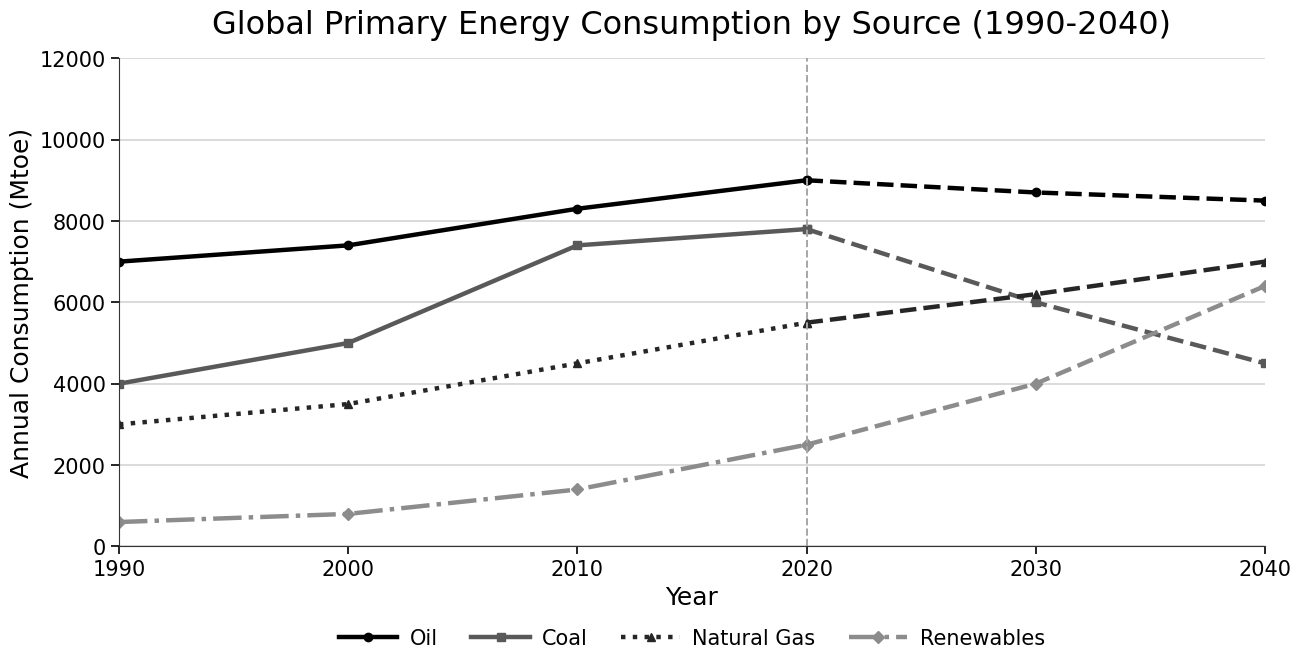
The graph below shows global primary energy consumption from four sources between 1990 and 2040, with figures after 2020 given as projections.

Summarise the information by selecting and reporting the main features, and make comparisons where relevant.
Academic Writing Task 1 Dynamic Multiple-Line Graph practice image
BAND 9

Part 1 · Band 9 Sample Answer

The line graph compares worldwide primary energy consumption from oil, coal, natural gas and renewable sources between 1990 and 2040, measured in million tonnes of oil equivalent, with the final two data points representing forecasts.

Overall, oil remains the dominant energy source throughout, despite a moderate decline after reaching a peak in 2020. Coal consumption is also expected to fall substantially, whereas natural gas and renewables continue to rise. By 2040, coal is projected to become the least-used source, while renewables experience the largest proportional increase.

Oil consumption grew from 7,000 Mtoe in 1990 to approximately 7,400 in 2000, before climbing to 8,300 in 2010 and peaking at 9,000 in 2020. Coal followed a steeper upward trajectory, rising from 4,000 to 7,800 Mtoe over the same period. Natural gas increased more steadily, from 3,000 to 5,500, while renewable consumption, initially negligible at roughly 600 Mtoe, reached 2,500 by 2020.

Thereafter, oil use is forecast to edge down to 8,700 Mtoe in 2030 and 8,500 in 2040. Coal is expected to decline far more sharply, falling to 6,000 and then 4,500. In contrast, natural gas consumption is projected to rise to about 6,200 in 2030, overtaking coal, and to 7,000 by 2040. Renewables will grow even faster, reaching 4,000 and 6,500 Mtoe respectively, thereby surpassing coal by the end of the period.

BAND 8

Part 1 · Band 8 Sample Answer

The line graph illustrates changes in global consumption of oil, coal, natural gas and renewable energy from 1990 to 2040. The figures are measured in Mtoe, and those for 2030 and 2040 are projections.

Overall, oil is the most heavily consumed source in every year shown. However, both oil and coal are predicted to decline after 2020, particularly coal. By comparison, natural gas and renewables are expected to continue growing, with coal becoming the least-used source by 2040.

In 1990, oil consumption stood at 7,000 Mtoe, considerably higher than coal at 4,000 and natural gas at 3,000. Oil then rose gradually to 7,400 in 2000 and 8,300 in 2010, before reaching 9,000 Mtoe in 2020. Coal increased more rapidly, climbing to 5,000 in 2000 and 7,400 in 2010, followed by a peak of 7,800 in 2020. Natural gas also grew steadily to 5,500 Mtoe, while renewables rose from around 600 to 2,500.

After 2020, oil consumption is forecast to fall slightly, reaching 8,500 Mtoe in 2040. Coal is projected to drop much more significantly, first to 6,000 in 2030 and then to 4,500. In contrast, natural gas will increase to roughly 6,200 and 7,000 Mtoe in these two years. Renewable energy is expected to show the fastest growth, rising to 4,000 in 2030 and 6,500 by 2040, when it will exceed coal consumption by 2,000 Mtoe.

BAND 7

Part 1 · Band 7 Sample Answer

The graph shows how much oil, coal, natural gas and renewable energy was consumed worldwide between 1990 and 2020, together with predictions for 2030 and 2040. The figures are given in Mtoe.

Overall, oil is the largest source of energy throughout the period. Oil and coal consumption are expected to decrease after 2020, while natural gas and renewables will continue to increase. Coal is predicted to have the lowest figure by 2040.

In 1990, the amount of oil consumed was 7,000 Mtoe. This rose to around 7,400 in 2000 and 8,300 in 2010, before reaching 9,000 in 2020. Coal also increased considerably, from 4,000 Mtoe in 1990 to 5,000 in 2000 and 7,400 in 2010. It reached its highest point of 7,800 in 2020. Natural gas grew more gradually from 3,000 to 5,500 Mtoe during these three decades. Renewables remained the smallest source, although their figure increased from about 600 to 2,500.

Oil use is forecast to fall slightly to 8,700 Mtoe in 2030 and 8,500 in 2040. Coal will decline more sharply to 6,000 and then 4,500. Meanwhile, natural gas is expected to rise to approximately 6,200 in 2030 and 7,000 in 2040. Renewable consumption will also grow quickly, reaching 4,000 and 6,500 Mtoe respectively. As a result, both natural gas and renewables will be used more than coal by the final year.

Academic Writing Task 2

Task 2 · Problems and Solutions Essay

Task 2 Prompt

You should spend about 40 minutes on this task. Write at least 250 words.

Write about the following topic:

Drugs and technologies that improve memory, concentration or learning ability may become widely available to healthy people in the future. However, some people are concerned that these cognitive enhancements could increase inequality because only wealthy individuals may be able to afford them.

What social and ethical problems could the widespread use of cognitive enhancements cause? What measures could be taken to reduce these problems?

Give reasons for your answer and include any relevant examples from your own knowledge or experience.

BAND 9

Part 2 · Band 9 Sample Answer

If medicines or technologies capable of improving memory, attention and learning become available to healthy people, they could transform education and employment. However, unrestricted use would raise serious questions about fairness, autonomy and safety. These risks could be reduced through strict regulation, equitable access policies and rules preventing coercion.

The most immediate social problem is the possibility of a self-reinforcing divide between rich and poor. Affluent families might purchase repeated enhancements for their children, giving them advantages in examinations, university admission and professional recruitment. Higher earnings would then allow the same group to afford even better treatments, turning economic privilege into an apparent difference in ability. Competition could also become unfair in another sense: achievements obtained with enhancement might be compared directly with those produced without it, even though the conditions were unequal.

There are also ethical concerns beyond access. Once enhancement becomes common, nominally voluntary use may become practically compulsory. Students might feel unable to compete unless they take concentration drugs, while employees could face pressure to remain productive for longer hours. This would weaken personal autonomy and expose healthy people to uncertain long-term side effects. Moreover, technologies that monitor or stimulate the brain could collect highly sensitive cognitive data, creating risks of surveillance and discrimination by employers or insurers. Society would also need to decide whether enhanced performance reflects genuine learning and effort, particularly in examinations and licensed professions.

A comprehensive regulatory system is therefore required. Enhancement products should undergo independent testing for long-term safety, and access should be restricted by age and medical risk rather than determined solely by purchasing power. If certain products are approved for general use, governments could subsidise basic versions or provide them through public healthcare and education systems. Schools, universities and employers should adopt transparent policies governing disclosure and permitted use, while explicitly prohibiting institutions from requiring enhancement as a condition of admission or employment. Strong privacy laws should prevent cognitive data from being sold or used to deny insurance and work opportunities.

Finally, regulation should be reviewed as evidence develops. Independent ethics bodies could monitor patterns of access, health outcomes and pressure on non-users, allowing rules to be adjusted before inequalities become permanent.

In conclusion, cognitive enhancement may widen existing social divisions, undermine voluntary choice and create new safety and privacy risks. Public oversight, fair access, anti-coercion protections and continuing ethical review would allow potential benefits to be pursued without permitting wealth or institutional pressure to determine who can compete.

BAND 8

Part 2 · Band 8 Sample Answer

Cognitive-enhancement drugs and technologies may eventually allow healthy people to improve their memory, concentration and ability to learn. Although these products could have useful effects, widespread use could create inequality, unfair competition and pressure to participate. Governments would need to regulate their safety and distribution while protecting people who choose not to use them.

A major concern is that expensive enhancements may only be available to wealthy individuals. Rich students could gain an additional advantage in examinations and university applications, while employees who can afford regular treatment might perform better or work for longer periods. Existing differences in education and income could therefore become even larger. The idea of merit would also become less clear because enhanced and unenhanced people would be competing for the same qualifications and jobs under different conditions.

Another problem is that voluntary enhancement could quickly become indirect coercion. If most workers in a competitive industry used concentration drugs, refusing them might damage a person’s career. Parents might also feel forced to enhance their children because other families were doing so. This pressure would be especially troubling if the long-term physical or psychological effects remained uncertain. Brain-related devices could create further ethical issues if they recorded private information about attention, emotions or mental performance.

Several measures could limit these problems. First, enhancement products should be tested and licensed in the same careful way as other medical treatments. Independent authorities should monitor side effects and prevent companies from making unsupported claims. Second, governments could subsidise approved products for low-income users or provide equal access through public institutions if the benefits were shown to be substantial. Schools and employers should publish clear rules about when enhancement is allowed, and they should be forbidden from requiring it. Examinations or safety-sensitive professions might need stricter restrictions to protect fairness and public confidence.

Finally, strong privacy laws should ensure that information produced by cognitive devices cannot be sold to employers, insurers or advertisers without genuine consent. Public education would also help people understand both the possible benefits and the risks.

In conclusion, cognitive enhancements could deepen social inequality and place unfair pressure on individuals while creating health and privacy concerns. Careful testing, affordable access, anti-coercion rules and data protection would be essential if these technologies became widely available.

BAND 7

Part 2 · Band 7 Sample Answer

In the future, healthy people may be able to use drugs or technology to improve memory, concentration and learning. These developments could be helpful, but they may also cause unfairness and several ethical problems. Governments should control how the products are tested, sold and used.

The first problem is unequal access. If cognitive enhancements are expensive, wealthy students may use them to achieve higher examination results, while poorer students must rely only on their natural ability and education. Similar differences could appear in the workplace, where enhanced employees might complete tasks faster and receive better salaries or promotions. As a result, people who are already financially successful could gain even more advantages.

There is also a risk that using these products would not remain a free choice. For example, students may feel that they must take a concentration drug because many of their classmates use it. Employers might prefer enhanced workers or expect staff to remain productive for very long hours. People could therefore use a drug even when they are worried about side effects. This is an important issue because the effects of taking enhancement products for many years may not be known. Devices connected to the brain could also collect private information about a person’s thoughts or mental condition.

To reduce these problems, governments should require thorough safety tests before any cognitive enhancement is sold. Advertising should be controlled so that companies cannot exaggerate the benefits or hide the risks. If an approved product provides a major educational or social benefit, financial support could help low-income people obtain it. This would reduce the advantage enjoyed only by the wealthy.

Schools and workplaces should also have clear rules. They should not force anyone to use enhancements, and examinations may need restrictions to ensure that candidates compete fairly. In addition, information collected by cognitive devices should be protected by strong privacy laws and should not be given to employers or insurance companies without permission.

In conclusion, widespread cognitive enhancement could increase inequality, create unfair competition and pressure people to take health risks. Strict safety regulation, support for equal access, protection for non-users and clear privacy rules could reduce these dangers.

FREE PRACTICE RESOURCES

Download the IELTS Practice PDF Pack.

Get Listening, Reading, and Writing practice materials for self-study. Use a computer to download the 1.9GB pack.

Download PDF Pack
Chat History
My Notes